
Fill a cell only when every arrangement still allowed by its row or column agrees. A confirmed empty cell can be as useful as a filled one.
Play Mini NonogramRead each clue as a group, not a total
A number tells you the length of a consecutive group of filled cells. In a five-cell row, clue 3 means one unbroken group of three. Clue 1 1 means two separate single cells, with at least one empty cell between them. Read row groups from left to right and column groups from top to bottom.
We label rows R1–R5 from top to bottom and columns C1–C5 from left to right. R2C4 is the fourth cell in the second row. A square is filled, a cross is confirmed empty, and a dot is still unknown. Unknown and empty are different while reasoning.
Start with a line that has only one arrangement
A five-cell line with clue 5 must be filled all the way across. Clue 3 alone is less specific: the group can start in cell one, two or three. Its middle cell is filled in every arrangement, but the two ends are not yet settled.
For a multi-group clue, count the required gaps too. Clue 2 2 needs two filled cells, one empty cell and two more filled cells: it fills the entire five-cell line as ■ ■ × ■ ■. You cannot join the groups into four adjacent cells.
The board below has row clues 1, 3, 5, 1, 1 and column clues 1, 2, 5, 2, 1. Row 3 and column 3 each contain a complete group of five, giving you a useful starting cross.
Solve the entire board in nine deductions
The teaching board comes from the same seeded generator as the playable Mini Nonogram. Each step lists every arrangement that still fits the selected line and its known cells. We mark only cells on which all those arrangements agree. The completed picture is not used as a hint during the deduction process.
Use Next deduction to reveal a line of reasoning, Previous to compare states, or try filled/empty for the next cell. Reset example affects only this untimed lesson. Open the full move list beneath the controls to read all nine explanations and the completed picture.
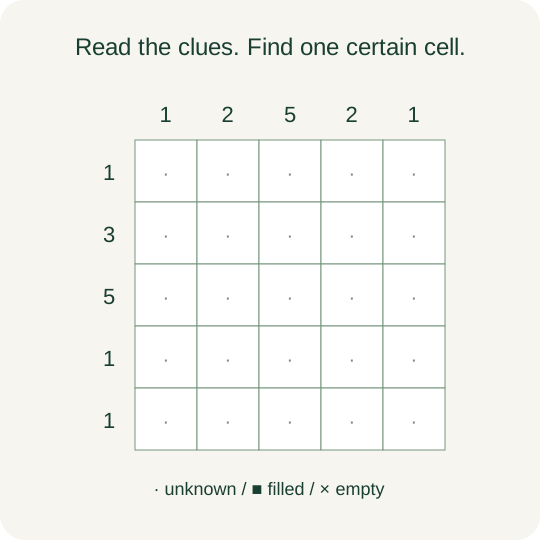
START WITH THE CLUES
Row 2 has clue 3 in five cells. All three possible arrangements fill its middle cell, R2C3. Begin with that overlap, then use the crossing lines.
Try the next deduction: should R2C3 be filled or empty?
Untimed teaching example. It does not start a game, save a score or affect your records. The play buttons open the real game; a fresh puzzle may differ.
Read all nine deductions and the completed picture
- Row 2, clue 3: 3 arrangements fit the clue and the cells already known: × × ■ ■ ■ or × ■ ■ ■ × or ■ ■ ■ × ×. Every remaining arrangement agrees on R2C3 filled. Mark these cells, then check the crossing lines.
- Row 3, clue 5: only one arrangement fits the clue and the cells already known: ■ ■ ■ ■ ■. Every remaining arrangement agrees on R3C1 filled, R3C2 filled, R3C3 filled, R3C4 filled, R3C5 filled. Mark these cells, then check the crossing lines.
- Column 1, clue 1: only one arrangement fits the clue and the cells already known: × × ■ × ×. Every remaining arrangement agrees on R1C1 crossed, R2C1 crossed, R4C1 crossed, R5C1 crossed. Mark these cells, then check the crossing lines.
- Column 2, clue 2: 2 arrangements fit the clue and the cells already known: × × ■ ■ × or × ■ ■ × ×. Every remaining arrangement agrees on R1C2 crossed, R5C2 crossed. Mark these cells, then check the crossing lines.
- Column 3, clue 5: only one arrangement fits the clue and the cells already known: ■ ■ ■ ■ ■. Every remaining arrangement agrees on R1C3 filled, R4C3 filled, R5C3 filled. Mark these cells, then check the crossing lines.
- Column 4, clue 2: 2 arrangements fit the clue and the cells already known: × × ■ ■ × or × ■ ■ × ×. Every remaining arrangement agrees on R1C4 crossed, R5C4 crossed. Mark these cells, then check the crossing lines.
- Column 5, clue 1: only one arrangement fits the clue and the cells already known: × × ■ × ×. Every remaining arrangement agrees on R1C5 crossed, R2C5 crossed, R4C5 crossed, R5C5 crossed. Mark these cells, then check the crossing lines.
- Row 2, clue 3: only one arrangement fits the clue and the cells already known: × ■ ■ ■ ×. Every remaining arrangement agrees on R2C2 filled, R2C4 filled. Mark these cells, then check the crossing lines.
- Row 4, clue 1: only one arrangement fits the clue and the cells already known: × × ■ × ×. Every remaining arrangement agrees on R4C2 crossed, R4C4 crossed. Mark these cells, then check the crossing lines.
Completed rows (■ filled, × empty): × × ■ × × / × ■ ■ ■ × / ■ ■ ■ ■ ■ / × × ■ × × / × × ■ × ×.
Use empty cells to pin down a group
After filling row 3 and column 3, a row with clue 1 already has its only filled cell. The other four cells must be empty. Cross them so you do not accidentally add another group later.
Column 1 also has clue 1. Once its row-3 cell is filled, its other cells must be empty. That excludes R2C1. In row 2, clue 3 can no longer start at C1; the crossing information then narrows the possible position of its three-cell group. Continue checking columns as well as rows.
A useful deduction may cross cells rather than fill them. The goal is a consistent picture, not the largest number of filled cells. In our example, the final filled rows form a small upward arrow.
Three mistakes that make a small Nonogram feel stuck
Do not add the clue numbers and fill that many arbitrary cells. The lengths, order and mandatory gaps all matter. A row with clue 1 1 cannot contain a group of two.
Do not treat a partially completed line as finished just because it contains enough filled cells. First check whether the groups are in the required order and whether any extra filled cell splits or joins them.
Do not assume that an unknown cell is already proved empty. In the game, unfilled cells count as empty when you press Check, but that does not make them logically settled during play. Use crosses to keep the reasoning visible.
Practice a fresh 5×5 picture
The Play Mini Nonogram buttons open the real game. A new practice board can use a different picture from the small seeded pattern bank, so follow its clues rather than copying this example. Each row and column must agree with the clues at the same time.
In this version, tapping a cell cycles blank → filled → crossed → blank. Crosses are optional for the final check: only filled groups are compared with the clues. Press Check after completing the picture. An incorrect check costs a point, and the five-minute clock continues.
This is a compact browser puzzle, not a numbered level walkthrough, a printable puzzle pack or a game with selectable difficulty and hint controls. No account or download is required.
Play Mini NonogramCommon questions
What do the numbers mean in a 5x5 Nonogram?
Each number is the length of a consecutive filled group. Multiple groups appear in order and need at least one empty cell between them. The row and column clues constrain the same cells.
What is the first deduction in this walkthrough?
Row 2 has clue 3 in five cells. All three possible placements include its middle cell, R2C3, so fill that cell. The next deduction fills row 3, whose clue 5 occupies the whole line.
Do I need to guess to solve this picture?
No. Every marked cell in this particular teaching board is forced by the surviving arrangements of a row or column. That claim applies to this verified example, not every Nonogram on the web.
Do crosses count as mistakes or filled cells?
No. A cross records a cell you believe is empty. In our game, Check compares only the filled groups against every clue. Crosses are optional, but useful for keeping track of deductions.
Does the tutorial solution work for my next game?
Not necessarily. Practice uses a small seeded bank of pictures. Read your current row and column clues; this article solves one specific generated teaching position.
Is the illustrated lesson timed?
No. The lesson does not start a game, save a score or change browser records. The separate playable Mini Nonogram has a five-minute limit.


