
A forced move can be one number left in a cell, or one place left for a number in a row, column or box. Update pencil marks after every confirmed placement.
Play Mini SudokuFirst, read the 6×6 grid
Use digits 1–6 exactly once in every row, every column and every heavy-bordered box. Each box is two rows tall and three columns wide. There are six boxes, not nine. A digit that fits a row can still be wrong for the column or box.
We label rows R1–R6 from top to bottom and columns C1–C6 from left to right. R2C3 means the cell in row two, column three. Printed clues are fixed. An empty cell is shown as a dot in the diagrams; the dot is not a zero you need to place.
Find the only possible number for a cell
For an empty cell, write down the missing row digits, then remove any digit already in its column or box. If one digit remains, you have a forced placement. If two or more remain, keep them as notes and examine another cell. A note is a possibility, not a commitment.
This example starts with row one: 5, blank, 1, 4, blank, 6. Its missing digits are 2 and 3. That information alone does not settle both cells. Start with a cell whose column and box reduce its possibilities to one; the walkthrough identifies that cell and explains the remaining candidate. You are combining constraints, not guessing from the row alone.
Start with a nearly complete row, column or box. If every empty cell still has several candidates, switch questions: where can one particular number go in a unit? The second case below demonstrates this only-place technique, also called a hidden single.
The complete illustrated solution
The starting board below is generated by the same deterministic generator as our game. It has one solution. The walkthrough checks every placement against the current board, rather than revealing a finished answer without explaining it.
Blue ? marks the next cell to deduce; gold marks the last filled cell. Try the next digit before revealing it, or select Next move to see one placement. Previous compares positions; Reset returns only this lesson to its starting board. All 22 explanations and the final rows are also available in the expandable transcript without JavaScript.
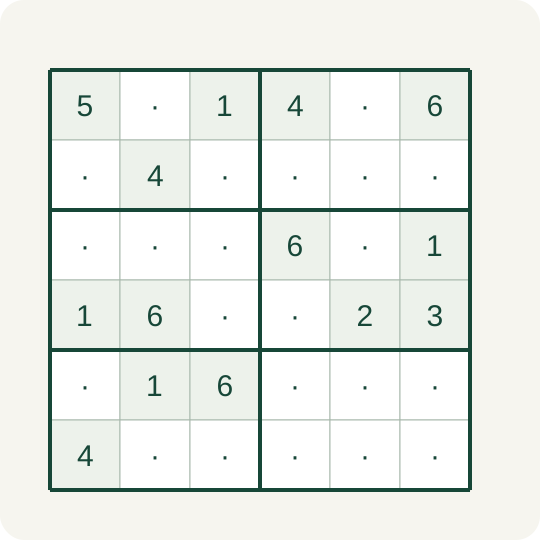
STARTING POSITION
Blue ? marks the next cell to deduce. Gold marks the last placement. The board changes only when you check a correct digit or reveal the next move.
Start with the printed givens. R means row and C means column. Select Next move to reveal one forced placement at a time.
Untimed teaching example. It does not start a game, save a score or change your daily streak. The play buttons open the puzzle options; choose Practice for a fresh board, which may differ from this example.
Read every move and the completed position
- R1C5 = 3. Row 1 is missing 2, 3. 2 is already in column 5. 3 is absent from both column 5 and this 2×3 box, so it is the only legal candidate. Place it, then scan again.
- R1C2 = 2. Row 1 is missing 2. The row has only one empty cell. 2 is absent from both column 2 and this 2×3 box, so it is the only legal candidate. Place it, then scan again.
- R2C3 = 3. Row 2 is missing 1, 2, 3, 5, 6. 1 is already in column 3 and this 2×3 box; 2 is already in this 2×3 box; 5 is already in this 2×3 box; 6 is already in column 3. 3 is absent from both column 3 and this 2×3 box, so it is the only legal candidate. Place it, then scan again.
- R2C1 = 6. Row 2 is missing 1, 2, 5, 6. 1 is already in column 1 and this 2×3 box; 2 is already in this 2×3 box; 5 is already in column 1 and this 2×3 box. 6 is absent from both column 1 and this 2×3 box, so it is the only legal candidate. Place it, then scan again.
- R4C4 = 5. Row 4 is missing 4, 5. 4 is already in column 4. 5 is absent from both column 4 and this 2×3 box, so it is the only legal candidate. Place it, then scan again.
- R3C5 = 4. Row 3 is missing 2, 3, 4, 5. 2 is already in column 5 and this 2×3 box; 3 is already in column 5 and this 2×3 box; 5 is already in this 2×3 box. 4 is absent from both column 5 and this 2×3 box, so it is the only legal candidate. Place it, then scan again.
- R4C3 = 4. Row 4 is missing 4. The row has only one empty cell. 4 is absent from both column 3 and this 2×3 box, so it is the only legal candidate. Place it, then scan again.
- R5C5 = 5. Row 5 is missing 2, 3, 4, 5. 2 is already in column 5; 3 is already in column 5; 4 is already in column 5. 5 is absent from both column 5 and this 2×3 box, so it is the only legal candidate. Place it, then scan again.
- R2C5 = 1. Row 2 is missing 1, 2, 5. 2 is already in column 5; 5 is already in column 5. 1 is absent from both column 5 and this 2×3 box, so it is the only legal candidate. Place it, then scan again.
- R2C4 = 2. Row 2 is missing 2, 5. 5 is already in column 4. 2 is absent from both column 4 and this 2×3 box, so it is the only legal candidate. Place it, then scan again.
- R2C6 = 5. Row 2 is missing 5. The row has only one empty cell. 5 is absent from both column 6 and this 2×3 box, so it is the only legal candidate. Place it, then scan again.
- R5C4 = 3. Row 5 is missing 2, 3, 4. 2 is already in column 4; 4 is already in column 4. 3 is absent from both column 4 and this 2×3 box, so it is the only legal candidate. Place it, then scan again.
- R5C1 = 2. Row 5 is missing 2, 4. 4 is already in column 1 and this 2×3 box. 2 is absent from both column 1 and this 2×3 box, so it is the only legal candidate. Place it, then scan again.
- R3C1 = 3. Row 3 is missing 2, 3, 5. 2 is already in column 1; 5 is already in column 1. 3 is absent from both column 1 and this 2×3 box, so it is the only legal candidate. Place it, then scan again.
- R3C2 = 5. Row 3 is missing 2, 5. 2 is already in column 2. 5 is absent from both column 2 and this 2×3 box, so it is the only legal candidate. Place it, then scan again.
- R3C3 = 2. Row 3 is missing 2. The row has only one empty cell. 2 is absent from both column 3 and this 2×3 box, so it is the only legal candidate. Place it, then scan again.
- R5C6 = 4. Row 5 is missing 4. The row has only one empty cell. 4 is absent from both column 6 and this 2×3 box, so it is the only legal candidate. Place it, then scan again.
- R6C2 = 3. Row 6 is missing 1, 2, 3, 5, 6. 1 is already in column 2 and this 2×3 box; 2 is already in column 2 and this 2×3 box; 5 is already in column 2; 6 is already in column 2 and this 2×3 box. 3 is absent from both column 2 and this 2×3 box, so it is the only legal candidate. Place it, then scan again.
- R6C3 = 5. Row 6 is missing 1, 2, 5, 6. 1 is already in column 3 and this 2×3 box; 2 is already in column 3 and this 2×3 box; 6 is already in column 3 and this 2×3 box. 5 is absent from both column 3 and this 2×3 box, so it is the only legal candidate. Place it, then scan again.
- R6C4 = 1. Row 6 is missing 1, 2, 6. 2 is already in column 4; 6 is already in column 4. 1 is absent from both column 4 and this 2×3 box, so it is the only legal candidate. Place it, then scan again.
- R6C5 = 6. Row 6 is missing 2, 6. 2 is already in column 5. 6 is absent from both column 5 and this 2×3 box, so it is the only legal candidate. Place it, then scan again.
- R6C6 = 2. Row 6 is missing 2. The row has only one empty cell. 2 is absent from both column 6 and this 2×3 box, so it is the only legal candidate. Place it, then scan again.
Completed rows: 5 2 1 4 3 6 / 6 4 3 2 1 5 / 3 5 2 6 4 1 / 1 6 4 5 2 3 / 2 1 6 3 5 4 / 4 3 5 1 6 2.
When no cell has one candidate: follow the only-place technique
A hidden single is a digit that has just one legal position within a row, column or box, even when that cell has other candidates. Check every possible position for that digit; several candidates in the cell do not invalidate this proof.
This second fixed board begins with no single-candidate cells. Follow four placements on the same board: two only-place deductions, then two deductions unlocked by updating pencil marks. It is a short technique case, not a second complete solution.
ONE BOARD · FOUR CONNECTED DEDUCTIONS · NO TIMER
1. Find the only place for 1 in row 2
Hidden single: one number, one place
| C1 | C2 | C3 | C4 | C5 | C6 | |
|---|---|---|---|---|---|---|
| R1 | · | 6 | · | 2 | 5 | 1 |
| R2 | 3 4 5 | 1 2 4 5 | 2 3 4 5 | 4 6 | 3 4 6 | 3 4 6 |
| R3 | 2 | 3 | · | 1 | · | 5 |
| R4 | · | · | 1 | · | 2 | · |
| R5 | 6 | · | · | 3 | · | 2 |
| R6 | 1 | · | · | · | · | · |
Shaded cells mark the row, column or box being checked. Small digits are possibilities, not entries. Gold marks the confirmed placement after you reveal it.
Check each cell’s possible digits
| Cell | Possible digits |
|---|---|
| R2C1 | 3, 4, 5 |
| R2C2 | 1, 2, 4, 5 |
| R2C3 | 2, 3, 4, 5 |
| R2C4 | 4, 6 |
| R2C5 | 3, 4, 6 |
| R2C6 | 3, 4, 6 |
Read all four deductions and the pencil-mark changes
Find the only place for 1 in row 2
R2C2 has four candidates: 1, 2, 4 and 5. Looking only at this cell does not settle it. Instead, look for the number 1 across row 2. Column 1 already has 1 at R6C1; columns 3, 4 and 6 already have 1 at R4C3, R3C4 and R1C6. R2C5 shares its top-right box with R1C6 = 1. Only R2C2 can hold the row’s 1, so place it there.
Clear the pencil marks inside R2C2 because it now contains a confirmed 1. A hidden single can have several candidates in its cell: the proof is that this number has no other place in the unit.
Keep the same board; look for 6 in column 3
R3C3 still has two candidates, 4 and 6. But the other empty cells in column 3 cannot contain 6: R1C3 has 6 in its row, R2C3 shares a box with R1C2 = 6, and rows 5 and 6 already contain 6 at R5C1 and R6C1. R4C3 is a fixed 1. This leaves R3C3 as the column’s only place for 6.
Place 6 at R3C3, then inspect its row, column and box for pencil marks that have become invalid. R3C5 was marked 4, 6. It now shares a row with a confirmed 6, so its 6 must be removed.
Update the notes at R3C5 before making the next move
Before the last placement, R3C5 allowed 4 or 6. The new 6 at R3C3 rules out 6 in the same row. Delete that pencil mark; 4 remains and still fits column 5 and the middle-right box. Now place 4 at R3C5. This is a naked single: one cell, one remaining number.
Placing 4 creates another notes update. R4C4 is in the same middle-right box. Its old notes 4, 6 must lose 4. The next step checks what that leaves.
Use the updated box notes to place the next 6
R3C5 and R4C4 belong to the same 2-row-by-3-column box. Once R3C5 is 4, remove 4 from R4C4’s notes. Only 6 remains; row 4 and column 4 also allow it. Place 6 at R4C4. Each move in this chain followed a proof, rather than a guess.
Four placements are complete, not the whole puzzle. Continue scanning for a cell with one candidate or a number with one place, and update notes after every confirmed entry. This fixed example is separate from today’s puzzle and your next practice board.
Maintain pencil marks after every confirmed placement
Notes in the real game are manual. Select an empty cell, turn Notes on and toggle the possible digits with 1–6. Before entering a confirmed number, turn Notes off. Entering that number clears its own cell’s marks; it does not automatically delete matching marks from other cells.
In the connected case, R3C5 initially has notes 4, 6. Once R3C3 becomes 6, remove 6 from R3C5 because both cells share row 3. Only 4 remains, so enter 4. Next remove 4 from R4C4’s old notes 4, 6 because it shares the same 2×3 box with R3C5. Only 6 remains there.
After each confirmed entry, revisit its row, column and box. Remove only the digits excluded by a sound deduction; deleting a possibility without a reason can manufacture a false single. Undo can reverse your own changes.
Conflict highlights detect repeated digits, not whether an entry matches the final solution. In the case’s starting position, 2 fits R2C2 without an immediate duplicate, yet it would wrongly take the only place for row 2’s 1. No red conflict does not prove a move is correct.
Practice a fresh puzzle after the lesson
Open Mini Sudoku, then choose Practice for a fresh board. If saved progress opens a daily puzzle, return to the puzzle options and choose Practice. Your board can differ from both teaching examples: look for a forced cell or an only-place digit rather than copying their answers.
The standard game has a five-minute clock. It continues while you are away, including when saved progress is resumed. A wrong completed-grid submission adds ten seconds to the adjusted result. Solved runs beat unfinished runs, then lower adjusted time wins. The untimed lesson above does not write a score, count as a game start, or change a daily streak.
For the shared daily puzzle, open the same game page and choose Today’s Sudoku. It changes at 00:00 UTC and keeps your first successful completion locally. This is separate from the site-wide rotating Daily Challenge. Use Practice while learning; choose Today’s Sudoku when you want the same board as other players.
Open Mini Sudoku — choose PracticeWhen you get stuck
If every cell has two or more candidates, scan for one number’s only position in a row, column or box. If nothing is forced, recheck your candidate lists against all three groups and revisit any earlier entries or unsupported deletions. Do not select an arbitrary legal digit and call it a deduction.
The complete first example needs only single-candidate cells; the second case adds hidden singles and note maintenance. These two techniques are not a guarantee that every generated puzzle will be solved by this exact sequence. The game does not label difficulty or provide answer-revealing hints.
Common questions
What if every empty cell has two or more candidates?
Look for a number that has only one possible position in a row, column or box. In the second case, R2C2 allows 1, 2, 4 and 5, but it is the only place for 1 in row 2, so it must be 1. This is a hidden single.
Do pencil marks update automatically in this game?
No. Notes are manual. A confirmed entry clears marks in its own cell, but you must remove invalid marks from other cells in its row, column and box. When R3C3 becomes 6 in the case, R3C5’s old notes 4, 6 must become 4 only.
Why can a number be wrong without a red conflict?
A conflict highlight detects a repeated digit, not every wrong deduction. In the second case, 2 is locally legal at R2C2, but row 2 has no other place for 1. Placing 2 there would make the puzzle impossible even without an immediate duplicate.
Can I try the example without starting the timer?
Yes. The walkthrough lets you enter the next explained digit or reveal the next move without starting a timed run or saving a result. The Play buttons open a separate fresh game.
Is this the solution to today’s Mini Sudoku?
No. It is a fixed teaching example. Today’s Sudoku and fresh practice boards can differ; use the deductions rather than copying these answers.
Does every Mini Sudoku puzzle have only one solution?
Our generator removes clues only while preserving one solution. This published teaching board has also been checked for uniqueness and every explained move has one legal candidate.


