
Read the top label and destination capacity before pouring. Judge a move by the useful layer it exposes, not just the matching colors it gathers.
Play Water SortThe rules in this version
Tap a source tube, then a destination tube. You can pour onto the same top label or into an empty tube, provided the destination has room. A pour moves as many adjacent matching top layers as will fit. You cannot choose to move a lower layer or split off an arbitrary amount.
Each tube holds three layers. The objective is for every nonempty tube to be full and contain one label. The remaining tubes stay empty. A tube holding only one A layer is not finished just because its visible layers match. Our version has a five-minute limit; it is not a numbered level collection.
Other Water Sort games may use four-layer tubes, extra containers or different assists. Apply the capacity shown in the game you are playing. The examples here use our three-layer rules only.
Read stacks from bottom to top
In the text notation [C, B, A], C is the bottom layer and A is the top. You can move A first; you cannot reach B until A is removed. Tubes are numbered 1–5 from left to right in both the diagram and the move list.
At the start, tube 2 is [C, B, A], tube 3 is [C, C, B], tube 4 is [B, A], tube 5 is [A], and tube 1 is empty. There are exactly three layers of each label in total. A good plan is to gather the A layers while exposing the B layers, then finish C.
Solve this board in five legal pours
Use Next move to see each actual board state. Read the explanation alongside it: the source top, destination top and available capacity explain why the move is legal. Previous and Reset let you compare positions without starting a timer or saving a result.
This is one verified solution for this specific starting board. Fresh practice generates another setup, so this move list is not a universal answer. An empty tube is useful space, but this example also demonstrates that you do not have to use every empty tube to finish.
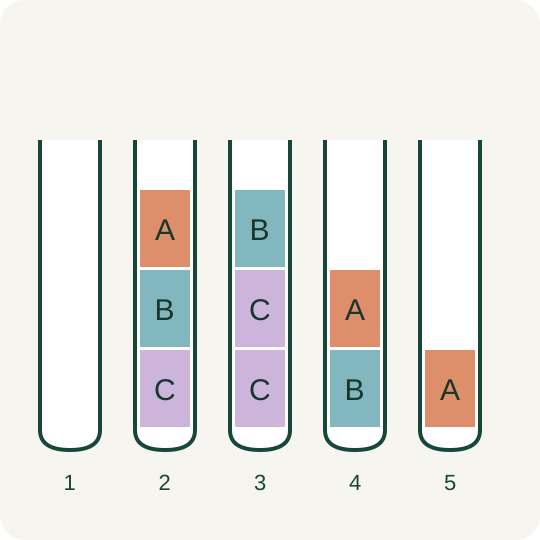
STARTING POSITION
Read each tube from bottom to top. A, B and C are labels, so you do not need to distinguish colors. Move 1 pours the top A from tube 2 into tube 4.
Untimed teaching example. It does not start a game, save a score or change your daily streak. The play buttons open a fresh game; its board may differ.
Read every move and the completed position
- Tube 2 → tube 4: pour 1 A layer. The destination has A on top and 1 free space. Check the newly exposed top layer before the next move.
- Tube 3 → tube 2: pour 1 B layer. The destination has B on top and 1 free space. Check the newly exposed top layer before the next move.
- Tube 4 → tube 5: pour 2 A layers. The destination has A on top and 2 free spaces. Check the newly exposed top layer before the next move.
- Tube 2 → tube 4: pour 2 B layers. The destination has B on top and 2 free spaces. Check the newly exposed top layer before the next move.
- Tube 2 → tube 3: pour 1 C layer. The destination has C on top and 1 free space. All nonempty tubes are now full and contain one label: solved.
Final tubes, bottom to top: empty; empty; C C C; B B B; A A A.
Two quick checks that prevent illegal moves
If the source is [A, B, B] and the destination is [B], both top B layers fit. The source becomes [A] and the destination becomes [B, B, B]. If the destination were [B, B], only one B would fit and the source would become [A, B].
If the destination top is C, those B layers cannot pour onto it. A matching label hidden lower in the destination does not make the pour legal: only its top label matters. Empty destinations accept a top group up to their available capacity.
Before tapping, ask: what is on top, how much room is there, and which layer will this move uncover? The fifth move in our example becomes possible because earlier pours expose the final C in tube 2.
Keep space useful, not merely occupied
An empty tube gives you somewhere to expose a buried layer. Avoid using it for a pour that simply moves a complete uniform tube from one place to another without improving the position. Such a move may be legal but often creates no new access.
A partly filled uniform tube can still be useful as a landing place for its label. Do not confuse it with a completed full tube. In our example, tube 5 starts with one A; gathering the other A layers there frees B in another tube.
Undo is available in the real game. It reverses a pour but does not pause the five-minute clock. If you keep going back and forth, stop and inspect what your next move will expose. This is a planning habit to try, not a guarantee of a minimum-move solution for every board.
Play Water Sort online and use the method
The game buttons open free browser practice without a download or account. Your new board can differ from the teaching example. Check top labels, free capacity and the effect of exposing the next layer instead of memorizing the five taps above.
A successful board leaves only full, single-label tubes and empty tubes. Finishing in practice is separate from stepping through this article. You can replay or share a seeded friend challenge after a real run; browser-reported results are informal and not a verified public ranking.
Water Sort and Bottle Order are different games. Here you move visible layers to group labels. Bottle Order asks you to infer a hidden bottle arrangement from position-match clues. A strategy for one does not supply a solution to the other.
Looking for the hidden bottle order? Learn to read position-match clues. →
Play Water SortCommon questions
How do you win this Water Sort puzzle?
Make each nonempty tube full of one label, leaving the other tubes empty. Each tube in this version holds three layers, with three colors and five tubes total.
Why can’t I pour into a tube that contains the same color?
Its top layer must match the source top, unless the destination is empty. It also needs free space. Matching a label lower in the tube is not enough.
Can I choose how many layers to pour?
No. A legal pour moves the matching top group as far as available capacity allows. If only one space is free, only one layer moves.
Is the five-move solution a walkthrough for every level?
No. It solves the fixed teaching position shown here. Practice uses seeded generated boards rather than a fixed numbered level list, so a fresh board can need different moves.
Can I undo a Water Sort move?
Yes in the real game, but the clock continues and Undo still counts as a move. The article Previous button only rewinds the lesson and does not affect a game or record.


